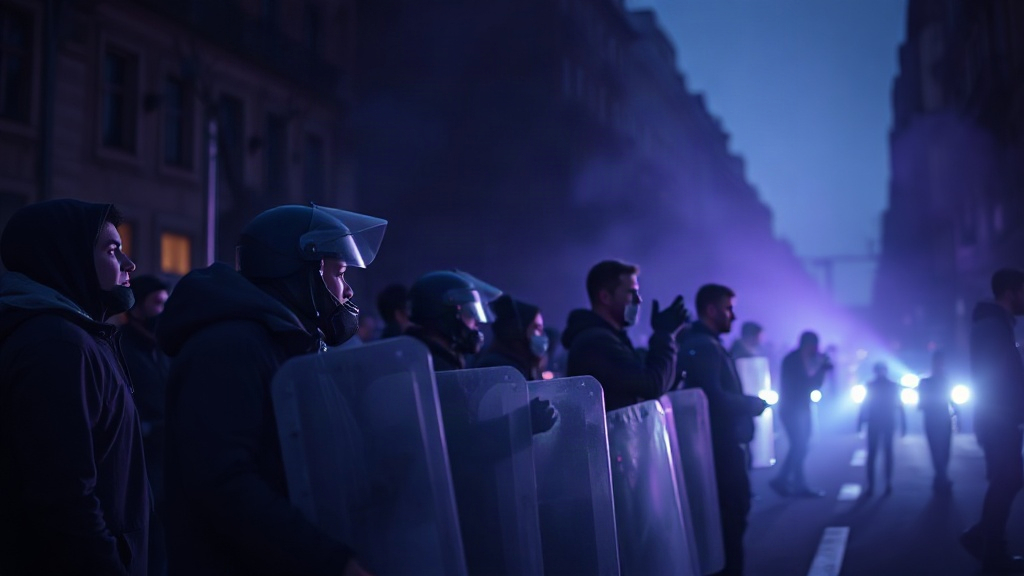
France’s weekend unrest revealed a protest movement that is no longer defined only by hardship, but by its capacity to destabilize public order. What started as demonstrations over school conditions and the cost of living drew an estimated 550,000 people, yet ended with at least 1,200 arrests, injured police officers, and widespread arson and looting. The scale of the violence, and the speed with which peaceful marches gave way to attacks on buildings and businesses, has turned the protests into a test of state authority as much as social discontent.
The evidence across cities points to a coordinated pattern of escalation. In Paris, riot police used tear gas and water cannon after fires were lit in the streets, vehicles were torched, and shops were ransacked. In Limoges, a blaze at the town hall caused part of the roof to collapse. Lyon’s tourist office was set alight, while police said hostile individuals blocked firefighters from responding safely. Similar damage was reported in Marseille, Rennes, Toulouse, Angers, Grenoble, Avignon, Pau, Montpellier and Valence. Authorities also described hooded individuals and targeted violence, while the BBC verified footage of masked men driving a tourist train toward riot police in Grenoble. Prime Minister Sébastien Lecornu said 150 officers were injured.
The unrest also reflects a deeper political fault line. Students protesting staff shortages and decaying schools have been joined by trade unionists and yellow vest activists, reviving a familiar French pattern of social anger merging with broader anti-establishment sentiment. That mix has sharpened the political stakes ahead of next year’s presidential contest, where Marine Le Pen and Jean-Luc Mélenchon are expected to dominate the field. Macron and Lecornu have framed the violence as criminal and politically opportunistic, while Mélenchon and Le Pen have traded accusations over who is exploiting the chaos.
The wider European context suggests France is not isolated. Similar anger over housing and living costs has spilled into Milan and Lisbon, where protests have also turned confrontational or become entrenched. Across the continent, inflationary pressure, housing scarcity, and institutional distrust are converging into a more volatile protest climate. The next question is whether governments can address the underlying grievances without allowing street violence to define the political agenda.